

Give me a pen! What I visualise when I hear “AI literacy”
Humans have always had a natural desire to communicate and organise information with one another. This can be considered the basic reason for literacy.
Long before books, classrooms and alphabets, humans found ways to communicate and preserve information beyond the immediate moment. Cave paintings, markings, symbols and eventually written language let us record ideas, share meaning and communicate across time and distance.
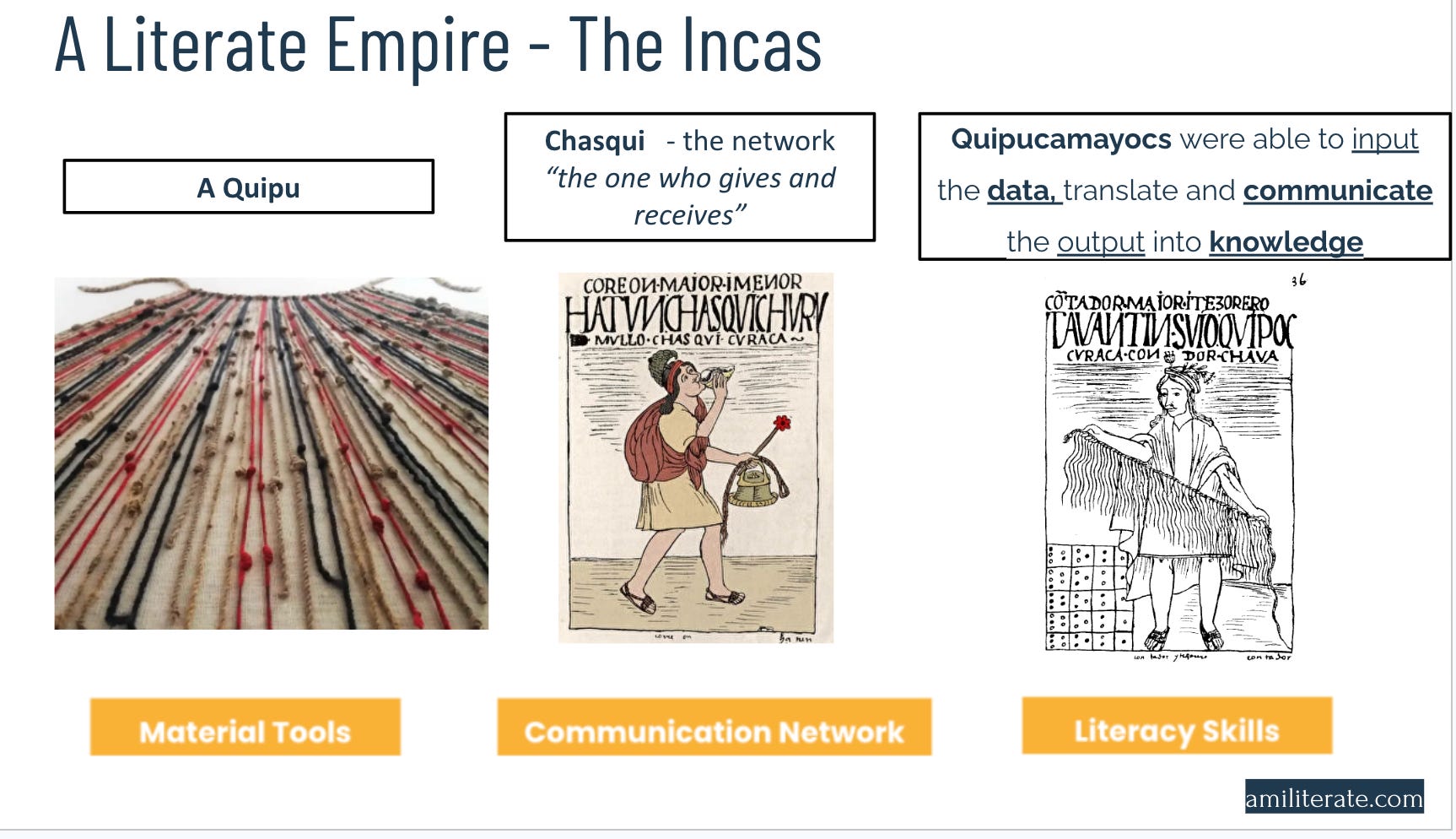
From my presentations and book, Am I Literate? Redefining literacy in the age of artificial intelligence
Our understanding of literacy evolved alongside society. Once defined narrowly as the ability to read and write, it then expanded to include numeracy, coding and, more broadly, digital literacy. Each expansion reflected the skills needed to participate in a changing world.
It helps to think of literacy as a combination of tools, channels and skills. Tools are what we use to create meaning: a pen, a printing press, a keyboard. Channels are how information moves from one place to another: postal networks, broadcasting cables, the internet. Skills let us encode what we want to communicate into a form that can travel through those tools and channels, and decode and interpret what comes back. When I pick up a pen to write on paper, I have the literacy skills to string letters into words and sentences, and to use them to communicate an idea. If I were the recipient of the letter, I would also have the skills not only to understand what is being said, but to interpret it, form an opinion, and respond meaningfully.
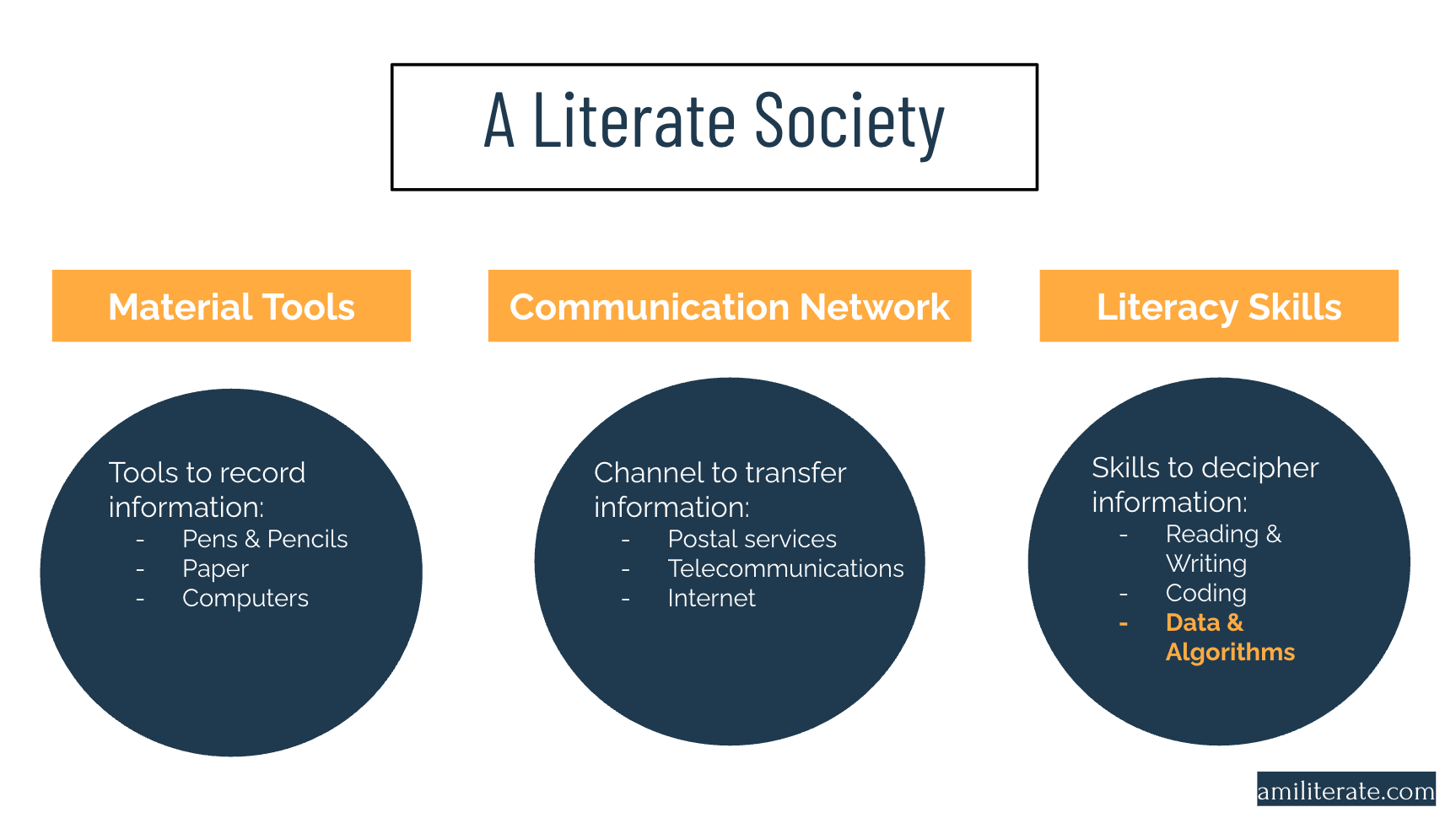
image: from my presentations 2025-2026
Every major shift in literacy changed one or more of these elements. The printing press transformed the tools and channels through which information could be shared, while the underlying skill of reading stayed largely the same. The internet transformed the channel again, while demanding new skills — navigating digital spaces, evaluating information, understanding how information is created, stored and shared.
We built the internet as a global communications network. From that network grew the digital world. And we built that digital world using our literacy skills: translating instructions into code, using mathematics to represent and process information, building systems on logic, rules, algorithms and patterns.
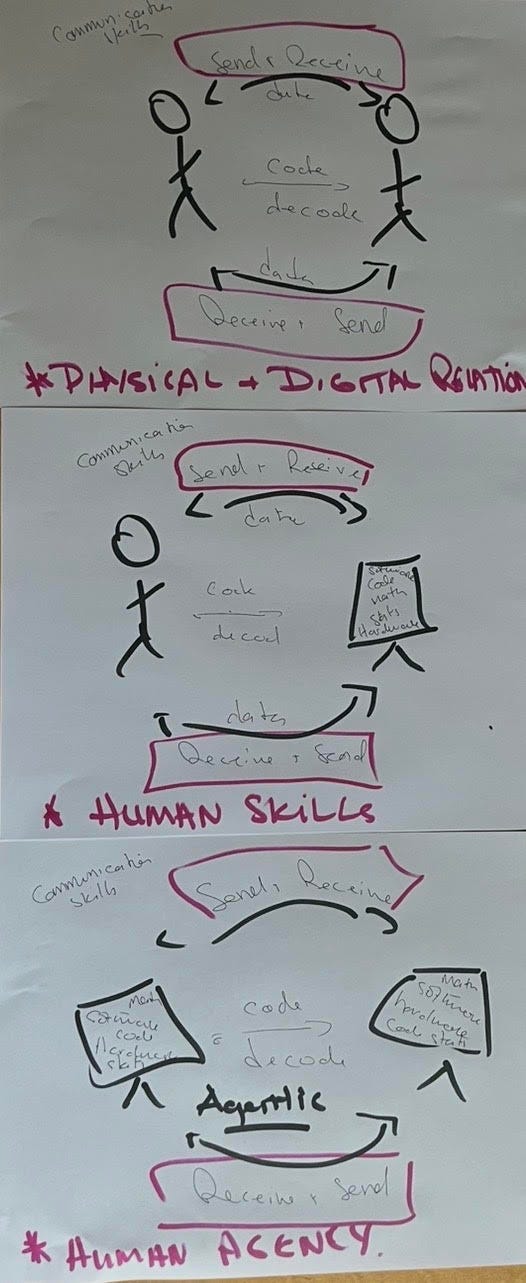
And what arose from the physical and digital worlds is artificial intelligence.
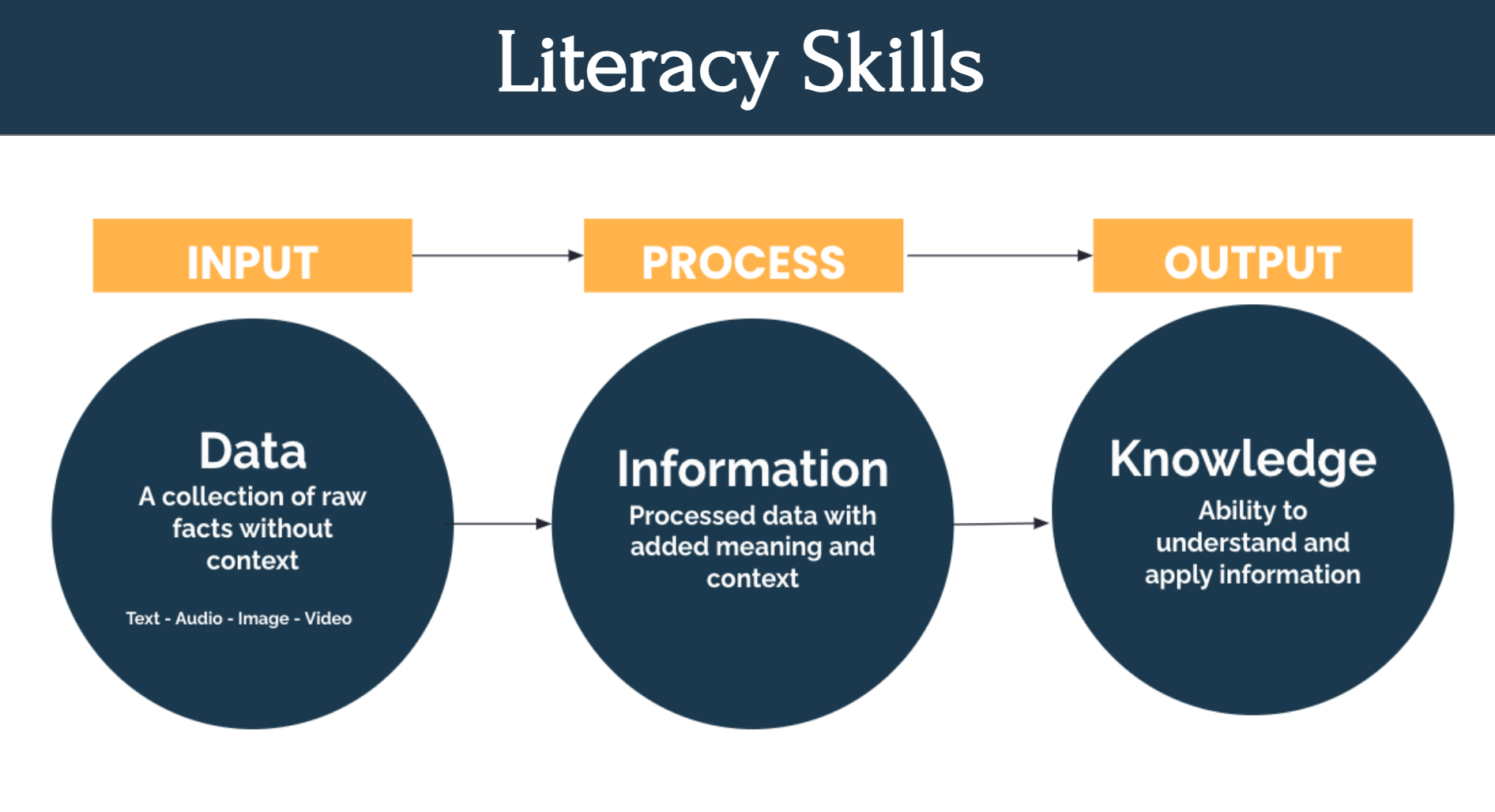
image: from my presentations 2025-2026
We are now in a world with another literate entity: machines.
AI machines can perform many of the processes of literacy, which changes a core component of literacy: communication itself.
For most of human history, literacy operated within a human communication system, supported by the tools, channels and social structures that allowed people to share information across distance and time. Now we communicate not only with other humans, but also with machines, and within systems where machines communicate with one another — agentic AI, where systems act on our behalf, reading, deciding and writing with little or no human review at each step.
This is a major source of the uncertainty and disruption we are seeing around the world. For the first time, machines can encode, decode and transform data into information on their own: combining the tools (data centres, computers, other hardware), channels (internet, cables, satellites) and skills (software, lines of code, mathematics, statistics) that literacy depends on, without human intervention.
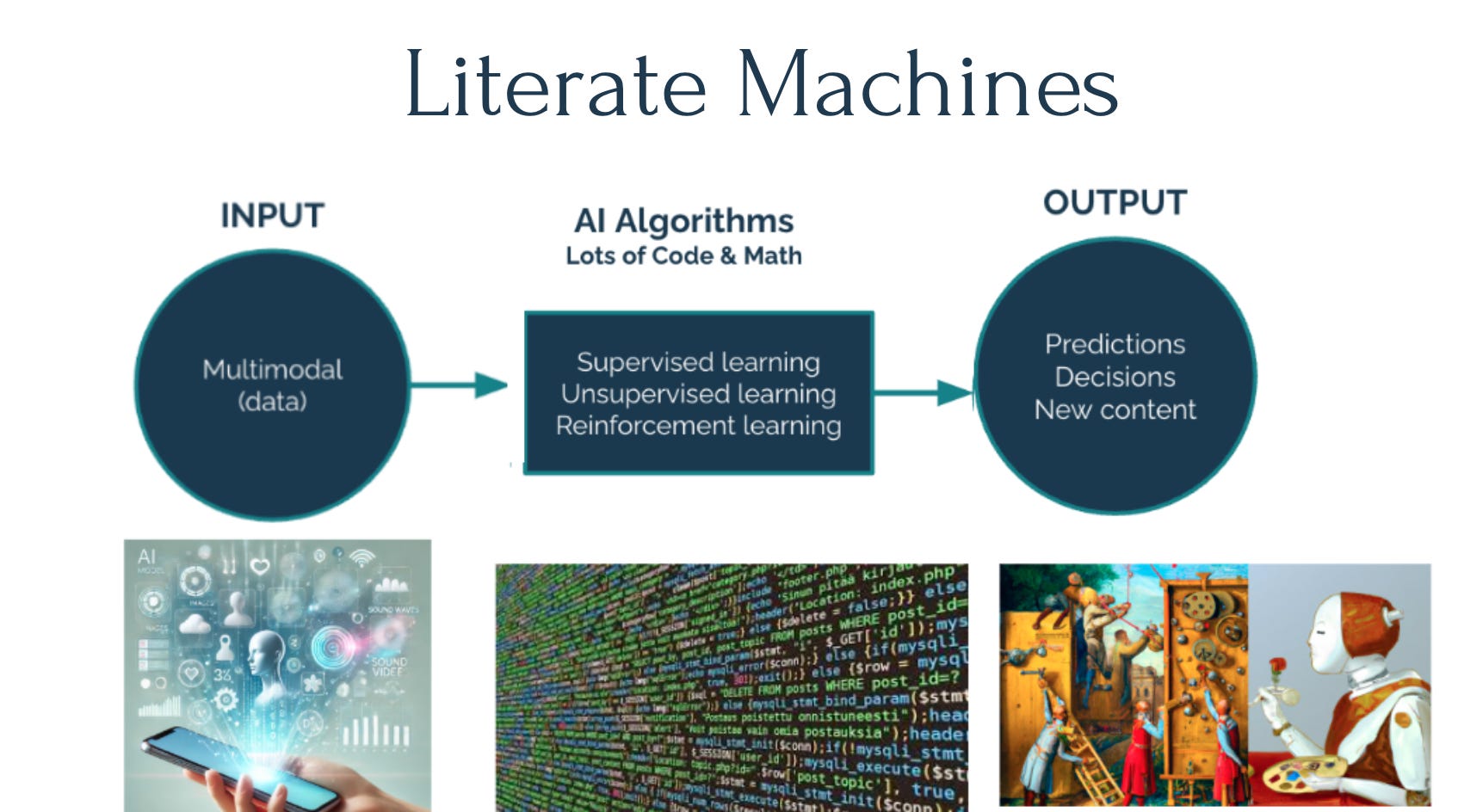
image: from my presentations 2025-2026
So what does literacy mean in a world where machines are now literate? It means our priority must be building human agency, much in the same way education systems focus on guiding the social and emotional wellbeing of our young people (highly recommend reading Sir Ken Robinson’s work on creativity, imagination and the broader purposes of education).
We need to strengthen communication between one another, and understand what it takes to communicate with machines. We need to nurture our imaginations and creativity, make space for curiosity and critical thinking, and take time to explore the natural world and our own inner voices.
We also need to understand AI itself: how these systems work, what they can and cannot do, where they fail, and how data and algorithms shape the information and choices around us (the tools and channels). AI literacy means being able to question, verify, interpret and make responsible decisions, rather than simply accepting what a machine produces.
And, importantly, we have to make sure foundational literacy skills — reading, writing, numeracy — are robust for all. Otherwise we risk widening the gap between those empowered by AI and those stunted by it.
I doubt there was a thoughtful debate between leaders before we started painting on cave walls. I think we reached for whatever tool was at hand: a burnt stick, a finger, a wall. Because we needed to communicate, to express and share with each other.
And to record information: capturing what we knew so it could outlive us, and reach places and people we’d never meet. That’s what let one generation’s thinking become the next generation’s starting point, or many people’s combined work become the next person’s great discovery. (A great book on this is Where Good Ideas Come From: A Natural History of Innovation by Steven Johnson.) It’s the quiet mechanism behind most of what we call innovation — not a single act of insight, but insight carried across distance and time, picked up and built on by someone else.
That instinct hasn’t changed. What has changed is that we’re no longer the only ones reading, recording and carrying information. Our job now is to make sure people stay literate enough, agentic enough, human enough, to remain authors of the conversation rather than its subjects — to build the agency needed to stay in it.
-30-
For more: literacyandai.com